DSS pushes for death penalty while defence demands acquittal in high-profile case linked to one of Nigeria’s deadliest church attacks….
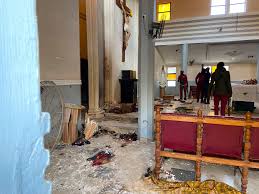
The Federal High Court in Abuja has reserved judgment in the trial of five men accused of participating in the deadly 2022 attack on St Francis Catholic Church in Owo, Ondo State, an incident that shocked the nation and left dozens dead.
Justice Emeka Nwite fixed the matter for judgment after hearing the final arguments from both the prosecution and defence teams in the terrorism case being prosecuted by the Department of State Services (DSS).
The judge informed lawyers representing both parties that a date for the verdict would be communicated to them by the court, adding that the notice could come within the next 24 hours.
During his closing argument, prosecution counsel Ayodeji Adedipe (SAN) urged the court to convict the defendants and impose the maximum punishment of death, insisting that the evidence presented throughout the trial clearly linked the accused persons to the attack.
Adedipe told the court that investigators carried out extensive work to uncover those behind the assault, describing the prosecution’s evidence as detailed and compelling. According to him, the case demonstrated the commitment of security agencies to ensuring justice for victims of one of the most devastating attacks on worshippers in recent Nigerian history.
However, defence counsel Abdullahi Mohammad asked the court to dismiss the charges and free his clients, arguing that the prosecution failed to prove its allegations beyond reasonable doubt.
The five defendants standing trial are Idris Abdulmalik Omeiza, Al Qasim Idris, Jamiu Abdulmalik, Abdulhaleem Idris, and Momoh Otuho Abubakar.
The attack occurred on June 5, 2022, during a church service at St Francis Catholic Church in Owo, headquarters of Owo Local Government Area in Ondo State. Gunmen reportedly stormed the church and opened fire on worshippers, killing more than 40 people and leaving several others injured.
The massacre triggered outrage across Nigeria and beyond, with religious leaders, civil society groups, and members of the international community demanding swift justice and stronger security measures to prevent similar attacks.
With judgment now pending, families of victims and survivors are waiting anxiously to see whether the court will hand down convictions in a case that has remained one of the country’s most emotionally charged terrorism trials.