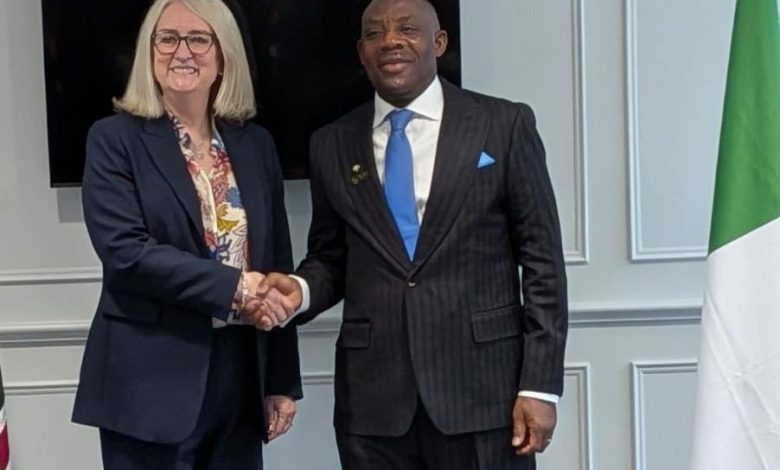
The Federal Government has strengthened its education and skills development partnership with the United Kingdom as part of efforts to prepare Nigerian youths for emerging global employment opportunities through expanded Technical and Vocational Education and Training (TVET), digital skills acquisition, and industry-driven apprenticeship programmes.
Ikharo Attah, Special Adviser (Media & Communications) to the Minister revealed this in a Statement today Saturday in Abuja.
According to the Statement, the Honourable Minister of Education, Tunji Alausa, disclosed this during a bilateral meeting with Baroness Smith on the sidelines of the Education World Forum in London.
The meeting focused on deepening cooperation in skills development, TVET reform, digital learning, workforce readiness, and apprenticeship systems aligned with global industry standards.
According to the minister, the collaboration forms part of the administration’s broader education reform agenda under President Bola Ahmed Tinubu aimed at repositioning technical education as a major driver of employment, industrialisation, innovation, and national productivity.
Alausa said the Federal Ministry of Education is aligning educational reforms with labour market demands to ensure Nigerian youths acquire practical and globally competitive skills needed in today’s economy.
He identified clean energy, healthcare, engineering, digital technology, and artificial intelligence as priority sectors critical to Nigeria’s economic transformation agenda.
“We are implementing a modern skills framework anchored on quality assurance, stronger industry participation, globally recognised accreditation, and structured apprenticeship pathways designed to meet current and future workforce needs,” the minister stated.
He further revealed that Nigeria is expanding collaboration with the United Kingdom through partnerships involving Federal Technical Colleges, the National Board for Technical Education (NBTE), IQM, and other relevant institutions.
The partnership is expected to support joint curriculum development, accreditation alignment, staff exchange programmes, and targeted skills-matching initiatives.
Both countries also agreed on plans for UK skills institutions to visit Nigeria to jointly develop programmes in clean energy, healthcare services, engineering, digital technology, and artificial intelligence.
Discussions also advanced on apprenticeship models aimed at improving alignment between training output and industry demand while ensuring programme quality and appropriate duration.
The meeting additionally explored ways to improve the perception and attractiveness of Technical and Vocational Education and Training by strengthening industry recognition and establishing clearer career progression pathways for learners, drawing lessons from ongoing reforms under Skills England.
On global education financing, Alausa, who serves as a member of the Global Partnership for Education (GPE) Board, called for continued UK support for the GPE 2026–2030 Replenishment Campaign.
Nigeria is expected to co-host the replenishment campaign alongside Italy during the margins of the United Nations General Assembly in New York in September 2026.
Responding, Baroness Smith commended Nigeria’s ongoing education reforms and expressed support for deeper bilateral cooperation in skills development and workforce preparation.
She also pledged to advocate sustained UK backing for the Global Partnership for Education ahead of the September 2026 replenishment campaign.
Observers say the renewed Nigeria-UK engagement reflects growing international confidence in Nigeria’s education reform agenda and the Federal Government’s determination to build a globally competitive workforce capable of meeting evolving economic demands.