
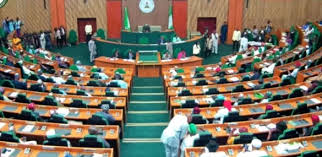
The House of Representatives has formally apologised to protesters affected by the deployment of tear gas at the National Assembly earlier this week, describing the incident as “regrettable” and assuring that the circumstances surrounding it are under thorough review.
The apology was delivered by House Spokesman Akin Rotimi during a press conference in Abuja to review the recently signed Electoral Act 2026. The event was organised by the Kukah Centre and Yiaga Africa in collaboration with the International Press Centre, TAF Africa, Centre for Media and Society, Nigerian Women Trust Fund, and ElectHer.
The Nigerian Police faced widespread criticism after operatives fired tear gas at demonstrators who returned to the National Assembly complex on Tuesday to demand mandatory inclusion of real-time electronic transmission of election results in the Electoral Act Amendment Bill, 2026. The protest followed a five-day suspension after prior assurances given to the demonstrators.
Expressing sympathy with those affected, Rotimi said, “I would like to express my sympathy with all those who were affected by the tear gas incident at the National Assembly the other day. It should never have happened, and we are taking steps to investigate the circumstances that led to it.”
He reaffirmed the constitutional right to peaceful protest while cautioning against infiltration by disruptive elements. “Protesters are entitled to express themselves, but we encourage vigilance to prevent nefarious actors from inciting disorder. The House of Representatives is intentional about public engagement,” he added.
Legislative Process and Civil Society Engagement
Rotimi defended the National Assembly’s handling of the Electoral Act review, emphasising that lawmakers acted in good faith and followed constitutional procedures. “Throughout the review of the Electoral Act 2022 and now the 2026 amendment, civil society organisations were actively involved,” he noted.
He urged Nigerians to maintain faith in the legislature, stating, “We have acted in the best interest of Nigerians, and we want citizens to continue to have hope, trust, and confidence in the National Assembly.”
On calls for the Independent National Electoral Commission (INEC) to conduct a nationwide simulation of its result transmission system, Rotimi welcomed the proposal.
He also endorsed the immediate publication of the newly assented Electoral Act to enhance transparency and public awareness.
Acknowledging widespread distrust in public institutions, Rotimi said, “We recognise that trust, apathy, and cynicism have been at an all-time low, especially towards the legislature. We are committed to working diligently to rebuild that trust.”
The press conference formed part of ongoing post-legislative engagements between lawmakers and civil society groups following the passage of the Electoral Act 2026—a law that has sparked intense debate over electronic transmission of results and other provisions ahead of the 2027 general elections.