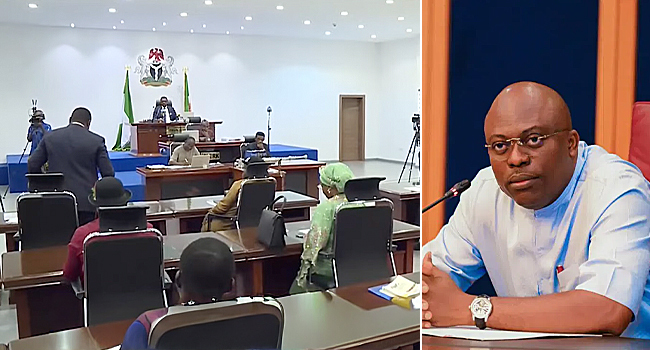
The Rivers State House of Assembly has suspended impeachment proceedings against Governor Siminalayi Fubara and his deputy, Ngozi Odu, effectively pausing a high-stakes political showdown that has gripped the state for weeks.
The decision was announced during Thursday’s plenary session presided over by Speaker Martins Amaewhule, following mounting legal and political complications that stalled further action.
Lawmakers resolved to halt the process pending the determination of ongoing court cases and broader consultations.
Allegations and Legislative Action
The impeachment process, initiated in January 2026, was anchored on allegations of gross misconduct under Section 188 of the Nigerian Constitution.
During plenary, Majority Leader Major Jack presented a notice outlining seven allegations against Governor Fubara.
These included the demolition of the Assembly complex, alleged extra-budgetary spending, withholding funds meant for the Assembly Service Commission, and purported disobedience of a Supreme Court ruling on legislative financial autonomy.
The notice, signed by 26 lawmakers, was to be transmitted to the governor.
Deputy Leader Linda Stewart also tabled allegations against Deputy Governor Odu, accusing her of unconstitutional expenditures, obstructing legislative functions, approving budgets through unauthorised channels, and withholding salaries and allowances.
Judicial Roadblocks
However, the impeachment drive soon encountered significant legal barriers.
The Rivers State Chief Judge, Simeon Chibuzor-Amadi, declined the Assembly’s request to constitute the mandatory seven-member investigative panel.
He cited a subsisting interim injunction issued by the Rivers State High Court as the basis for his refusal.
The restraining order, granted on January 16, 2026, by Justice Florence A. Fiberesima, barred the Chief Judge, the Speaker, and the Clerk of the House from taking further steps in the impeachment process.
The injunction followed suits filed by Fubara and Odu challenging the legality and constitutionality of the proceedings.
The Rivers State chapter of the All Progressives Congress (APC) also weighed in, rejecting the impeachment attempt as “destabilising and unnecessary.” The development sparked widespread reactions from political stakeholders and Nigerians across the country.
Presidential Mediation and a Fragile Truce
Amid escalating tensions, President Bola Ahmed Tinubu was reported to have convened a closed-door meeting at the Presidential Villa involving Governor Fubara and the Minister of the Federal Capital Territory, Nyesom Wike—the governor’s political mentor and predecessor.
Fubara was also said to have visited Wike at his residence in Guzape, Abuja, in what appeared to be a symbolic gesture of reconciliation.
Wike later confirmed the meeting, revealing that it was initiated by the President on Monday, February 9, as part of renewed efforts to defuse the political crisis in Rivers State.
Expressing appreciation for Tinubu’s intervention, Wike voiced optimism that the move would foster lasting peace, noting that it was the second time the President had stepped into the dispute and expressing hope that “it would be the last.”
The mediation came shortly after a third impeachment notice had reportedly been issued by lawmakers believed to be loyal to Wike.
A Recurring Political Storm
The unfolding drama marks the second impeachment attempt against Fubara and Odu.
A similar move in March 2025—triggered by a bitter rift between Fubara and his predecessor, Wike—plunged the state into a full-blown political crisis.
The standoff escalated to the point where President Tinubu declared a state of emergency in Rivers State, suspended the governor, his deputy, and lawmakers for six months, and appointed retired naval chief Ibokette Ibas as sole administrator.
Fubara later returned to office following a political reconciliation involving himself, Wike, and members of the legislature.
The state’s political landscape shifted yet again in December when Fubara defected from the Peoples Democratic Party (PDP)—the platform on which he was elected in 2023—to the ruling APC, further reshaping alliances and intensifying the power struggle.
While the Assembly’s decision to halt the impeachment signals a temporary de-escalation, Rivers State remains on delicate political footing. With court rulings pending and rival factions still navigating uneasy alliances, the coming weeks are likely to determine whether the current truce evolves into lasting stability—or another chapter in the state’s turbulent political saga.