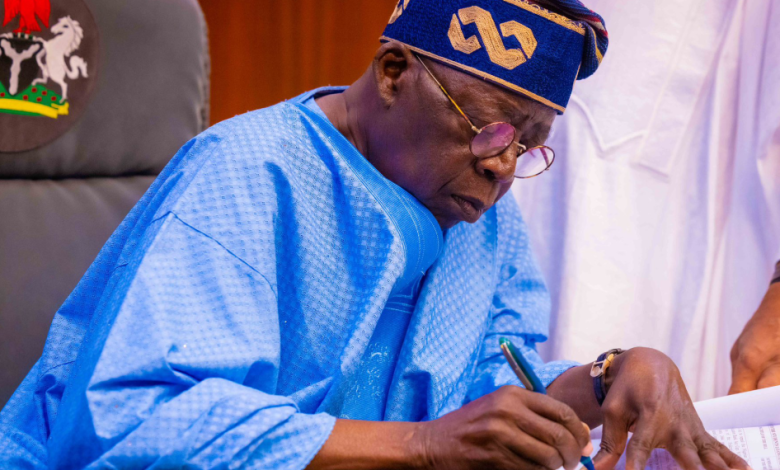
President Bola Tinubu has officially signed the Electoral Act 2022 (Repeal and Re-Enactment) Bill 2026 into law, marking a transformative shift in Nigeria’s democratic framework ahead of the 2027 general elections. The presidential assent follows a high-stakes legislative marathon that culminated in the National Assembly’s final approval on Tuesday. The new legislation emerged from months of rigorous deliberation, but its final passage was marred by an explosive row in the Senate, where lawmakers clashed over the controversial methods for transmitting election results.
The upper chamber descended into a rowdy session as proceedings resumed with a sharp demand for a division over Clause 60, spearheaded by Senator Enyinnaya Abaribe (ADC/Abia South). Senate President Godswill Akpabio initially attempted to move past the request, claiming he believed the demand had been previously withdrawn, but a chorus of opposition senators immediately challenged his assertion. Deputy Senate President Barau Jibrin tried to de-escalate the tension by citing Order 52(6), arguing that revisiting a prior ruling from the chair would breach parliamentary order. This intervention only intensified the uproar, leading to a brief but heated confrontation between Senator Sunday Karimi and Senator Abaribe.
“The Senate President, Godswill Akpabio, had stated that he believed the demand had previously been withdrawn, but several opposition senators immediately objected to that claim. Citing Order 52(6), the Deputy Senate President, Barau Jibrin, argued that it would be out of order to revisit any provision on which the Senate President had already ruled. This submission sparked another uproar in the chamber, during which Senator Sunday Karimi had a brief face-off with Abaribe. The Senate Leader, Opeyemi Bamidele, then reminded lawmakers that he had sponsored the motion for rescission, underscoring that decisions previously taken by the Senate are no longer valid.”
Senate Leader Opeyemi Bamidele eventually clarified the procedural standing, noting that his motion for rescission had effectively nullified previous decisions, thereby validating Abaribe’s call for a division. Akpabio suggested the move was a performance for the public, but he ultimately sustained the point of order. Invoking Order 72(1), Abaribe formally moved for a division on Clause 60(3), specifically targeting a proviso that permits manual transmission of results in the event of electronic network failure. Abaribe argued that Form EC8A should remain the primary basis for results and sought to eliminate the manual transmission loophole to prevent potential manipulation.
The subsequent physical division saw Akpabio direct senators to stand according to their vote. While 15 opposition members rose in support of removing the manual transmission proviso, a dominant majority of 55 senators stood to uphold it. This victory for the pro-manual caveat ensured the inclusion of a “fail-safe” mechanism in the law, despite critics’ fears that it might undermine the integrity of electronic voting systems. Earlier in the day, the Senate had briefly stalled during the clause-by-clause consideration, forcing a move into a closed-door session for private consultations after murmurs and huddles formed around the Senate President’s desk.
With the 2026 Act now signed, the Independent National Electoral Commission (INEC) gains new flexibility, including an amended timeline that allows for the adjustment of the 2027 election dates to avoid a clash with the Ramadan fasting period. While the government hails the Act as a step toward modernization, the heated debates and the narrow defeat of mandatory electronic-only transmission suggest that the battle over electoral transparency remains a focal point for the Nigerian electorate.