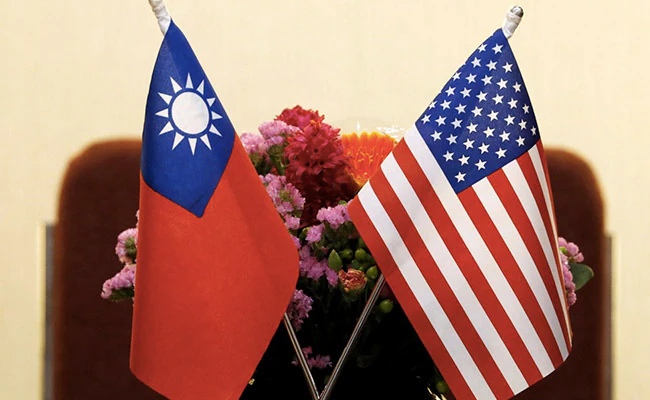
US President Donald Trump says he will soon decide whether to approve additional weapons sales to Taiwan, even as Chinese President Xi Jinping urges Washington to tread carefully on what Beijing considers its most sensitive red line.
“I’m talking to him about it. We had a good conversation, and we’ll make a determination pretty soon,” Trump told reporters, stressing that he maintains a “good relationship” with the Chinese leader.
The matter featured prominently during a February 4 phone call between the two presidents, in which Xi called for “mutual respect” in bilateral ties and warned against further US arms transfers to the self-governed island.
“The Taiwan question is the most important issue in China-US relations… The US must handle arms sales to Taiwan with caution,” Xi said, according to China’s state broadcaster.
Both leaders are expected to meet in Beijing in April, with Taiwan likely to be a central topic of discussion.
A Longstanding Flashpoint
Although China’s Communist Party has never ruled Taiwan, Beijing claims the democratic island of 23 million people as part of its territory and has not ruled out the use of force to achieve what it calls “reunification.”
The United States does not formally recognize Taiwan as an independent state but remains its principal security partner and largest arms supplier under long-standing defense commitments.
In December, Washington approved an $11 billion arms package for Taipei. Days later, China responded with extensive live-fire military drills, simulating a blockade of Taiwan’s major ports — a move widely interpreted as a warning against deepening US–Taiwan defense ties.
Diplomatic Warnings and Political Pressures
Despite adopting a somewhat softer rhetorical tone toward Taiwan in his second term, Trump continues to navigate one of the most delicate issues in US–China relations.
Over the weekend, China’s top diplomat, Wang Yi, cautioned the United States against “instigating and plotting to split China through Taiwan,” warning that crossing Beijing’s “red line” could provoke confrontation. He made the remarks at the Munich Security Conference in Germany.
Meanwhile, Taiwan is under growing pressure — particularly from Washington — to bolster its own defense capabilities. President Lai Ching-te has proposed an additional $40 billion in defense spending over eight years to modernize the island’s military.
However, the initiative has been blocked at least ten times since early December by Taiwan’s opposition-controlled parliament, stalling what supporters argue is a critical investment in deterrence.
Last week, dozens of US lawmakers urged Taiwan’s opposition parties to end the impasse and approve the expanded defense budget, reinforcing Washington’s expectation that Taipei assume greater responsibility for its security.