
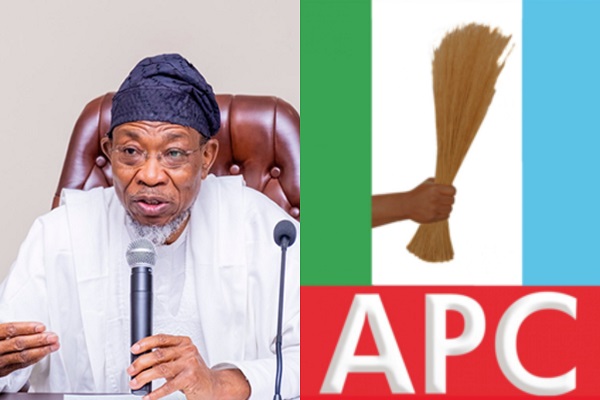
The Lagos State Chapter of the All Progressives Congress (APC) has taken note of recent comments attributed to the former Governor of Osun State, Rauf Aregbesola, in which he suggested that the defection of governors would not influence the outcome of the 2027 general elections and sought to exaggerate the opposition’s performance in Lagos during the 2023 presidential election.
While reaffirming that every citizen is entitled to freely express an opinion, the Lagos APC considers it necessary to place the facts on record and address the omissions, selective narratives, and sweeping conclusions embedded in Mr. Aregbesola’s remarks.
In a statement signed by the spokesman of the Lagos State APC, Seye Oladejo, the party stressed that it is misleading to isolate Lagos from the broader national electoral context.
President Bola Ahmed Tinubu’s victory in the 2023 presidential election was neither accidental nor regional. It was the outcome of a carefully built national coalition, the attainment of the constitutionally required spread, and the support of Nigerians across diverse regions.
Presidential elections are decided nationally—not on the performance in any single state, regardless of its symbolic significance.
The statement further noted that attempts to elevate the opposition’s performance in Lagos during the presidential election deliberately ignore subsequent electoral realities. The result neither altered the national outcome nor endured beyond that contest.
Only weeks later, Lagos voters reaffirmed their confidence in the APC by re-electing the party in the governorship election. Even more instructive, subsequent bye-elections across the state produced clear victories for the APC, underscoring the party’s enduring structure, organisational strength, and grassroots acceptance in Lagos.
Contrary to claims that the Lagos outcome diminished President Tinubu’s stature, the result in fact strengthened his democratic credentials. The victory of an opposition candidate in a state governed by his party highlighted the credibility of the electoral process and reaffirmed the President’s commitment to democratic principles, political plurality, and the rule of law.
On the issue of defections, the Lagos APC emphasised that the party has never maintained that defections alone win elections. Electoral success is driven by performance, credibility, leadership, organisation, and a compelling vision for governance.
Where defections occur in favour of the APC, they reflect growing public confidence in the ruling party and deepening dissatisfaction with opposition parties beset by internal disunity, weak cohesion, and the absence of clear ideological direction.
The party acknowledged the unease and anxiety that recent political realignments have generated within opposition circles, noting however that political relevance is sustained by ideas, unity, and delivery—not rhetoric, polemics, or selective narratives.
It is also noteworthy, the statement added, that some individuals who once benefitted immensely from the progressive political platform built by Asiwaju Bola Ahmed Tinubu now seek relevance by attempting to downplay his political legacy.
History remains consistent and resistant to revisionism: the political evolution of modern Nigeria cannot be meaningfully discussed without recognising President Tinubu’s foundational role in coalition-building, leadership development, and the institutionalisation of progressive governance.
As the nation looks ahead to 2027, the APC reaffirmed its commitment to governance, economic reform, national stability, and improving the lives of Nigerians.
The party urged all political actors to rise above polemics and engage the electorate with ideas, solutions, and verifiable records—rather than selective memory or political revisionism.


