French Senate Approves Landmark Bill to Curb Fast Fashion’s Environmental Impact

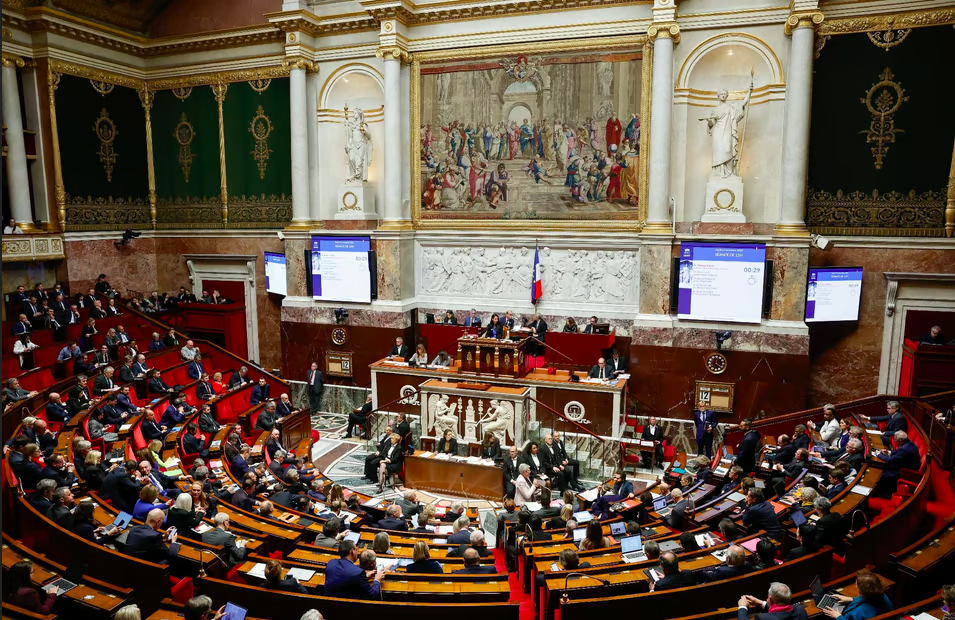
In a pioneering move to combat the environmental devastation and overconsumption fueled by the burgeoning fast fashion industry, the French Senate is poised to vote on a groundbreaking bill on Tuesday, June 10, 2025.
The proposed legislation aims to impose financial penalties on companies and ban advertisements for ultra-fast fashion, signaling a significant shift in environmental policy.
The bill, which has already received overwhelming support from the lower house National Assembly in March 2024, is primarily targeted at the likes of Chinese-founded e-commerce giant Shein, notorious for its rapid production cycles and low-cost, high-volume apparel.
These easily ordered and disposable items are flooding the French market, contributing significantly to pollution and market saturation.
With strong backing from the government and widespread support across the Senate, the bill is widely expected to pass today. While this vote is a major hurdle cleared, it’s not the final legislative step; a joint committee of senators and lower house deputies is anticipated to meet from September to reconcile the text before its final adoption into law.
“This text plans to reduce the environmental impact of the textile industry,” explained Anne-Cecile Violland, the centre-right Member of Parliament who spearheaded the bill.
The urgency is clear: between 2010 and 2023, the value of advertised fast fashion products in France soared from 2.3 billion euros to 3.2 billion euros.
Data from the state environmental agency Ademe reveals a staggering 48 clothing items per person are released into the French market annually, with 35 items discarded every single second.
Agnes Pannier-Runacher, the Minister for Ecological Transition, powerfully articulated the “triple threat” posed by fast fashion: “It promotes overconsumption, causes ecological disaster and threatens our businesses.” Slamming an “invasion” of products designed for obsolescence, the minister expressed optimism that this legislation could inspire similar changes across Europe. Once adopted, the European Commission will be formally notified to ensure compliance with EU law.
The Senate, dominated by the right-wing, introduced amendments to specifically target “ultra” fast fashion companies, such as Asian online retailers Shein and Temu, while consciously seeking to exempt established French and European brands like Zara, H&M, and Kiabi.
These traditional fashion giants will nonetheless be obligated to inform customers about the environmental impact of their products.
“I have no intention of making French brands that contribute to our country’s economic vitality pay a single euro,” affirmed rapporteur Sylvie Valente Le Hir, a member of The Republicans party.
The core of the bill introduces a progressive sanction system based on an “eco-score” that assesses the environmental communication of fast fashion companies.
Those with the lowest scores will face government taxes, starting at up to 5 euros per product in 2025 and escalating to 10 euros by 2030, though this tax cannot exceed 50 percent of the original product’s price. Crucially, the bill also proposes banning fast fashion advertisements and imposing sanctions on influencers who promote such products.
The industry’s reaction is mixed. Quentin Ruffat, a spokesperson for Shein, told RTL radio on Monday that effective regulation requires a “collective effort” rather than targeting “a single actor,” warning that the proposed 10-euro tax could “impact the purchasing power” of French consumers.
Environmental organizations, while supportive of the intent, express concerns about potential misinterpretations and whether the law will have sufficient substance, as noted by Green Senator Jacques Fernique.
The Textiles Industry Union (UIT) welcomed the bill as “a first step,” hoping for its “rapid adoption… even if the text does not entirely fit our expectations.”
If passed, France’s initiative could set a precedent for other nations grappling with the environmental and social consequences of the rapidly expanding fast fashion industry.