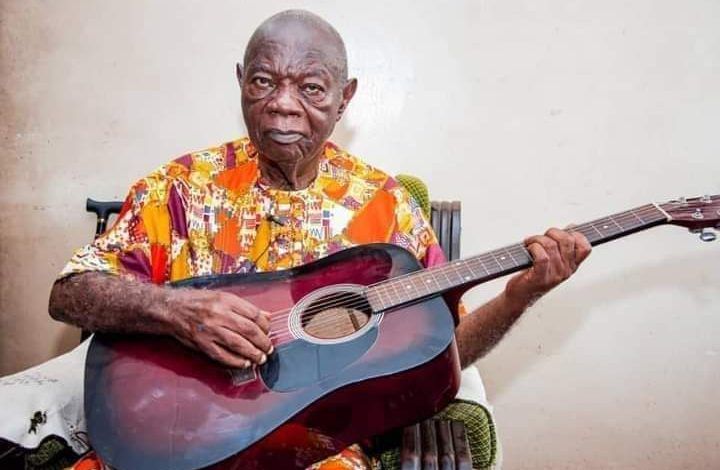
Legendary highlife musician, folklorist, and cultural custodian Chief Mike Ejeagha has passed away at the age of 95, marking the end of an era in Nigerian music and oral tradition.
Ejeagha died at approximately 8 p.m. on Friday, June 6, 2025, at the 32 Garrison Hospital in Enugu, following a prolonged 16-year battle with prostate cancer. His passing was confirmed by his eldest son, Emma Ejeagha, who was by his side during his final moments.
Born on April 4, 1930, in Imezi Owa, Ezeagu Local Government Area of Enugu State, Mike Ejeagha began his musical career in the 1950s and soon distinguished himself through a rare blend of highlife rhythms, Igbo folklore, and proverb-laced storytelling.
With more than 300 recorded songs, many of which are preserved in the National Archives of Nigeria, he became a vital voice in the preservation of Igbo language and culture.
Nicknamed “Gentleman Mike” for his calm demeanor and philosophical lyrics, Ejeagha was not only an entertainer but also a moral teacher whose songs conveyed deep wisdom in simple language.
His music enjoyed a renaissance in 2024, when his 1983 classic, “Ka Esi Le Onye Isi Oche,” resurfaced in a viral global dance challenge initiated by comedian Brain Jotter, captivating a new generation of fans.
In recognition of his invaluable cultural legacy, the Enugu State Government, under Governor Peter Mbah, in 2024 renamed Obinagu Road as Chief Mike Ejeagha Road—a longstanding wish of the music icon that had gone unfulfilled for decades. The governor has since pledged to further immortalize Ejeagha’s contributions to the arts and society.
“Mike Ejeagha was more than a musician—he was a national treasure, a guardian of tradition, and a storyteller whose words will echo through time,” Governor Mbah said in a tribute posted to social media. “His passing leaves a cultural void that will be hard to fill, but his legacy will live on for generations.”
Ejeagha’s health had steadily declined over the years, with frequent hospitalizations since his cancer diagnosis in 2006.
According to his son, the music icon had requested not to be embalmed or kept in the morgue for long, preferring a simple farewell in line with his grounded philosophy of life.
Throughout his six-decade career, Mike Ejeagha remained deeply rooted in the community, choosing a life of simplicity even as his influence extended far beyond Nigeria’s borders. His songs remain staples at cultural festivals, family gatherings, and educational settings—often used to teach language, values, and history.
He is survived by his children, extended family, and an enduring musical catalogue that continues to inspire and educate.
Plans for his funeral and further state honors are expected to be announced in the coming days.