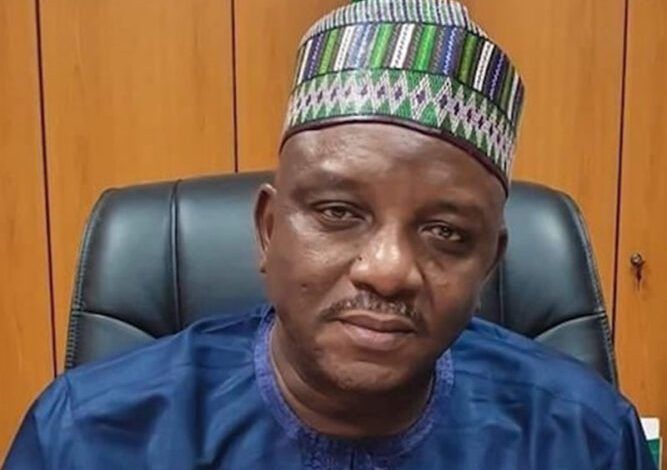
In a dramatic turn at the Federal High Court in Abuja, a lead investigator with the Economic and Financial Crimes Commission (EFCC) has testified that former Minister of Power, Saleh Mamman, made a series of voluntary confessional statements each in the presence of his legal counsel or trusted associates during the agency’s probe into an alleged ₦33.8 billion fraud linked to the stalled Mambilla Power Project.
Taking the witness stand before Justice James Omotosho, EFCC operative Abubakar Kwaido served as the prosecution’s first witness in the ongoing trial-within-trial, a legal process used to determine the admissibility of Mamman’s statements, which the defence claims were obtained under duress.
But Kwaido firmly rejected the notion of coercion.
“I was surprised to hear that he was allegedly threatened,” Kwaido told the court. “As seen in the video recordings, the defendant and his lawyers were often smiling. All statements were either handwritten or dictated by him voluntarily, in the full presence of his counsel or close associates.”
According to an official statement shared by the EFCC via its verified Facebook page on Thursday, Mamman provided statements on 10, 11, 12, 15, 17, and 19 May, as well as 3 and 9 August 2023, during multiple interrogation sessions.
Kwaido detailed how, at each session, the ex-minister was accompanied by legal representation or a confidant:
11 May – P.A. Aderungi (counsel), 12 May – P.A. Adewuyi and Aliyu Musa, 15 May – Muzzarril Yahaya, 17 May – Umar Yunusa, 19 May – Paul Adetako, 3 August – Rabiu (business partner), 9 August – Sulieman Yusuf.
This level of transparency, the EFCC suggests, contradicts claims of forced confessions — a defense angle some media outlets have reported on without highlighting the presence of legal counsel during each statement.
Mamman faces a 12-count charge filed by the EFCC, centered on allegations of criminal conspiracy and money laundering amounting to ₦33.8 billion — funds purportedly linked to diverted contracts under the long-delayed Mambilla Hydro-Power Project, once heralded as Nigeria’s most ambitious energy infrastructure.
While defence counsel, Femi Atteh, SAN, moved to block the admission of the extra-judicial statements, arguing they were extracted under coercion, the court sided with the prosecution. Rotimi Oyedepo, SAN, prosecuting for the EFCC, presented what the court deemed compelling grounds for admissibility.
Justice Omotosho admitted the statements as evidence and adjourned the matter to Friday, 27 June 2025, for continuation of cross-examination.
As several mainstream reports skim the surface of courtroom proceedings, the granular testimony provided by Kwaido along with the EFCC’s video evidence — paints a deeper and more complex picture of an ex-minister who may have confessed not under pressure, but in full legal awareness.