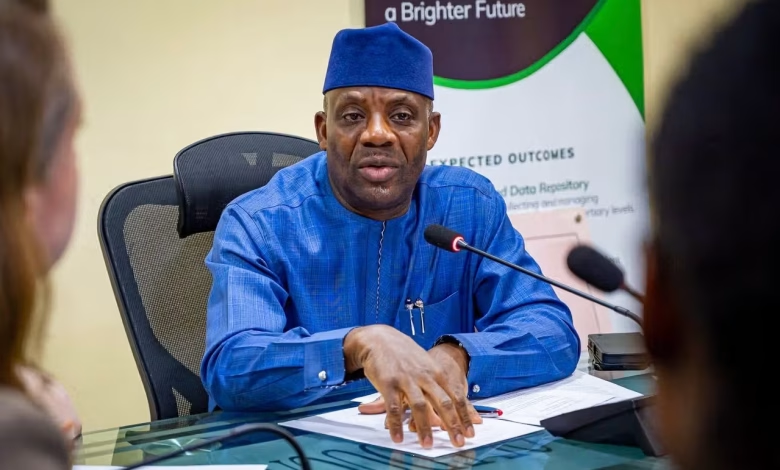
Nearly 20 million Nigerian children may be dropping out between primary and junior secondary school, highlighting what the Minister of Education, Tunji Alausa, described as the country’s biggest education challenge – access.
Alausa disclosed this on Wednesday at the 2026 Annual Education Summit of the Education Correspondents Association of Nigeria in Abuja, where he said Nigeria’s education crisis goes beyond enrolment figures to ensuring children progress through the school system.
The minister urged journalists to rely on official data to hold governments accountable and encouraged education reporters to embrace investigative and data-driven reporting.
He directed journalists to use the Nigeria Education Data Infrastructure Management System, NEDIMS, which provides information on schools, teachers, classrooms and learning facilities nationwide.
“If you don’t use data, it is like you are flying blind. Without data, you cannot do anything”, Alausa said.
He said access to reliable data would enable journalists to assess issues such as teacher availability, classroom capacity and learning conditions across the country.
Alausa said the Tinubu administration had prioritised education reforms through investments in technical and vocational training, STEM, digital transformation, quality assurance and improved governance. He highlighted three years of uninterrupted academic activities in tertiary institutions and said 24 Nigerian universities are now ranked among the world’s top 1,000 institutions.
However, he maintained that access remains the sector’s biggest challenge, noting that while nearly 25 million children are enrolled in primary schools, only about five million continue to junior secondary education. He attributed the gap to inadequate infrastructure, pointing out that Nigeria has about 90,000 primary schools compared with only 16,000 junior secondary schools.
The minister said government interventions had returned more than one million children to classrooms in the last two years, while the ministry is working with the National Bureau of Statistics to obtain updated figures on out-of-school children.
Other stakeholders at the summit called for stronger accountability, improved funding, better infrastructure and evidence-based reporting to support ongoing education reforms.