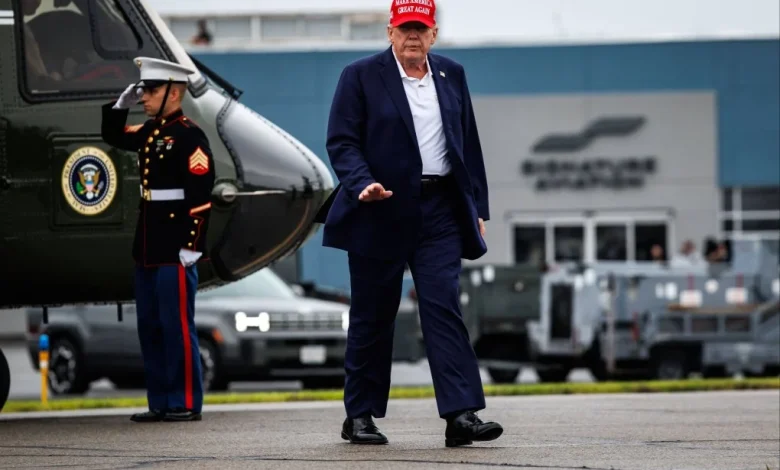
US President Donald Trump has directed the Pentagon to substantially scale back joint military exercises with South Korea, reigniting questions over Washington’s long-term military commitment to one of its key Asian allies.
Trump announced the directive on Sunday, citing the cost of the exercises and Seoul’s reluctance to participate in US efforts related to the war with Iran.
He also pointed to his relationship with North Korean leader Kim Jong Un, arguing that the continued drills could send an unnecessarily hostile signal to Pyongyang.
The order came as the annual Ulchi Freedom Shield exercises were set to begin. Despite Trump’s directive, South Korean and US forces commenced the drills on Monday as scheduled.
The exercise is due to run through August 27 and involves about 18,000 South Korean troops, with training focused on preparing the allies to respond to evolving threats, including drones, cyberattacks and disruptions to satellite navigation systems.
South Korea’s government said it was reviewing Trump’s remarks while reaffirming its commitment to maintaining a strong combined defence posture with Washington. Seoul also indicated that it was considering possible military support related to Iran, but said such decisions must take into account the country’s security situation on the Korean Peninsula and domestic legal requirements.
Trump’s latest move revives a longstanding disagreement over the scale and cost of US-South Korean military exercises. He has previously criticised the drills as expensive and provocative and suspended major exercises following his 2018 summit with Kim, before they were later resumed as negotiations with North Korea stalled.
The decision comes at a particularly sensitive moment on the Korean Peninsula. North Korea has stepped up its missile activity ahead of the exercises, including a ballistic missile launch from its eastern coast last week. Pyongyang routinely condemns the US-South Korean drills as preparations for an invasion, while Washington and Seoul maintain that the exercises are defensive in nature.
Trump’s directive could therefore have broader implications for the US-South Korea alliance, particularly if a reduction in military exercises affects operational readiness or is interpreted by Pyongyang as a shift in Washington’s regional strategy.
At the same time, the president’s continued emphasis on his relationship with Kim suggests that renewed diplomacy with North Korea may remain an important element of his approach to security on the Korean Peninsula.